It's 7:10. Your customer hands you the keys and says, “I have a meeting at ten. That should be plenty of time, right?”
You have three people behind them. The vehicle has an intermittent warning light. Nobody has inspected it yet.
“We should be able to make that work” would get you through the next ten seconds. It could also create the hardest conversation of your afternoon.
The customer heard a commitment. You meant a possibility. Once the keys are on your desk, that difference belongs to you to explain.
This is where setting expectations at service check-in matters. Before the customer leaves, you need a shared understanding of what happens next, what requires their decision, and when you will contact them.
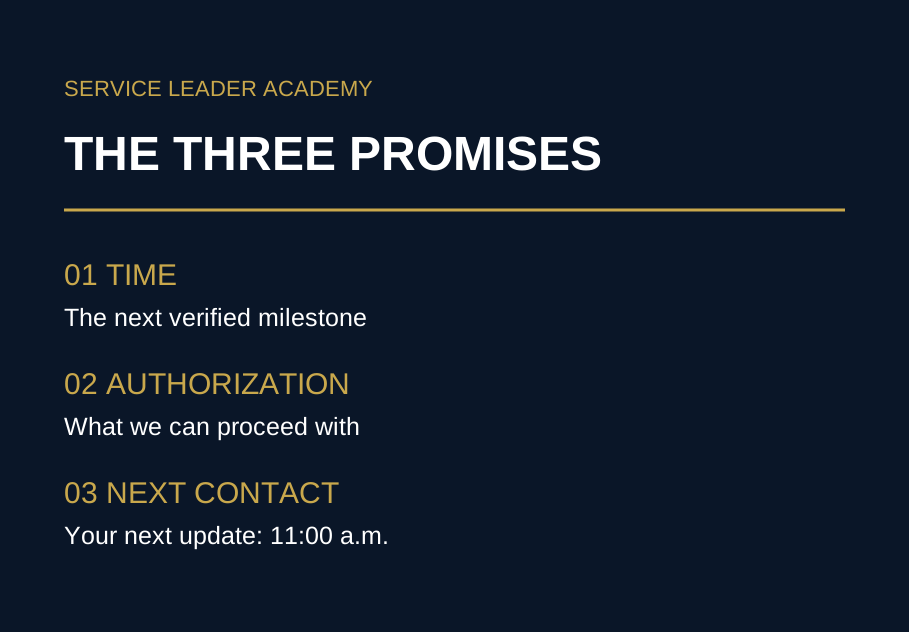
I use a framework called the Three Promises: time, authorization, and contact. Those three commitments give the visit a structure both of you can follow.
The customer remembers the promise you made
A vehicle finished at 3:30 can produce two very different conversations.
If you promised three, the customer rearranged their day around something you missed. If you gave an honest four-thirty expectation and finished early, they had useful information and got a welcome call.
That does not mean adding hours so you can look good. Customers need a realistic plan, not a number designed to make the advisor comfortable.
The question is simple: could you explain your timing out loud?
“There are two vehicles ahead of yours, and we need to complete testing before I can confirm the repair plan” gives the customer something real. “It should be fine” gives them an assumption.
Your first minute on the service drive starts the relationship. The agreement you make after that greeting gives the relationship something to stand on.
Promise one: name the next timing milestone
An appointment time, a technician's inspection, a diagnosis, and a completed repair are different events. Explain which one you can reasonably discuss right now.
For a warning light that has not been diagnosed, try:
“Your appointment gets the vehicle checked in with me. We still need testing before I can tell you what the repair involves. I'll update you by eleven with our status and the next step.”
For a routine service, confirm the current workload before quoting a completion window. Include the inspection and final checks in your thinking. If your store cannot support the customer's deadline, say so while they still have choices.
“I understand ten is your deadline. I can't commit to having this concern diagnosed and repaired by then. Let's work out whether leaving it today fits your plans.”
That conversation can feel awkward. It is still easier while the customer can arrange transportation than after they have been waiting for two hours.
Ask one useful question before they leave:
“When do you need the vehicle back, and what do you have planned around that time?”
A school pickup and a preference to leave before traffic are both important. They may require different plans. You only learn that by asking.
Promise two: explain the authorization boundary
Customers should understand what they are authorizing now and what will require another conversation.
“We'll inspect it” can mean very different things to the person saying it and the person hearing it. Explain the actual scope using your dealership's estimate and authorization process.
“Today you're authorizing the work listed here. If testing shows that additional work is needed, I'll explain the findings and get the required authorization before that additional work begins.”
Then check understanding:
“Is that the same understanding you have of what we're doing today?”
Use the written repair order to support the conversation. A vague verbal assurance should not have to carry the entire agreement.
Be equally clear about uncertainty. You might be verifying coverage, waiting for an inspection, or checking whether a part is available. Tell the customer which question remains open.
“I haven't confirmed coverage yet. I'll verify it before I describe this as a covered repair.”
You are not making the visit sound complicated. You are preventing an unanswered question from becoming an accidental promise.
Promise three: put a clock on the next contact
“I'll call you when I know something” sounds reasonable until you realize it could leave the customer waiting all day.
Give a specific time you can honor, through the customer's preferred contact method.
“Would you prefer a call or a text? I'll update you by eleven, even if we're still waiting for testing to begin.”
Repeat the contact details. Check that texts reach a number the customer actually uses. If they cannot answer during work, agree on how you will leave an update and how they can respond.
The update time is a commitment to communicate. It does not guarantee a completed diagnosis.
That distinction matters when nothing has changed. You can still say:
“I'm checking in as promised. The vehicle is still waiting for testing. I don't have findings to review yet. I'll check its progress again and update you by one.”
Keep the message factual. Do not say a technician is working on it unless you have verified that. A reassuring story that turns out to be wrong creates a second problem.
Read the agreement back before taking the keys
You do not need to deliver a speech. Bring the Three Promises together in a short recap.
“We're checking the warning light you described, especially when it appears on your morning drive. I can't confirm a completion time before testing. We're proceeding with the authorization on this repair order, and I'll contact you before any additional work begins. You'll hear from me by eleven by text, even if testing is still pending.”
Then ask:
“What part of that plan do we need to adjust before you go?”
This gives the customer room to tell you something they have not mentioned. They might need the car seat, have a second concern, or have misunderstood what today's visit could accomplish.
Write the agreement in the RO notes. Set a reminder for the contact time. If another advisor covers you, they need to see the same plan the customer heard.
When the customer needs certainty you cannot give
Sometimes they ask again: “But you think it'll be ready, right?”
You can acknowledge the need without turning uncertainty into a yes.
This is part of handling difficult customer conversations without taking them personally: acknowledge the pressure the customer is under, then stay with what you can verify and deliver.
“I know you need a firm answer so you can plan. I don't have enough information to give you a reliable completion time yet. What I can commit to is updating you by eleven and helping you work through the available options.”
Offer only options you have checked. Transportation, another appointment, or a different repair plan may be possible, but confirm availability before promising any of them.
If the customer chooses not to leave the vehicle under those conditions, document the conversation and follow your store's process. Getting the keys is not a successful check-in if both people leave with different understandings.
Repair a missed commitment early
Even an honest plan can change. A test takes longer. The inspection reveals another concern. A part is unavailable.
Contact the customer as soon as you know the agreement needs to change.
“I need to revise the timing we discussed this morning. Testing is taking longer than expected, and I don't have a confirmed completion time. I wanted to tell you now so we can plan your next step.”
If you missed the promised update, own that directly:
“I said I'd contact you by eleven, and I missed that. I'm sorry. Here's the verified status, and here's when you'll hear from me next.”
You do not need to blame the shop to explain the situation. Give the facts, acknowledge your commitment, and make the next one realistic. Those habits also support better CSI through consistent communication.
Questions advisors ask about check-in expectations
Should I give a completion time before diagnosis?
Only give timing supported by the information and workflow available. If the repair is unknown, explain the next milestone and commit to an update instead.
What if the customer says their appointment guarantees immediate work?
Explain what the appointment means at your store. Acknowledge the misunderstanding and describe the actual next step without criticizing whoever booked it.
Do I still contact the customer when nothing has changed?
Yes, when you promised an update. State the verified status, what happens next, and the next contact time.
How do I remember all those callback commitments?
Record them in the RO and use your dealership's task or reminder system. Include the communication plan in any handoff. Memory alone is a fragile process on a busy drive.
Join the free Service Leader Academy community on Skool for Phase 1 training, weekly challenges, and the Resource Library, free. Built from real service-drive experience, the training gives you practical language you can use at any brand. Start Free at ServiceLeaderAcademy.com.
Related Articles
 Handle Customers
How to Handle Difficult Customers Without Taking It Personally
Learn a calm service advisor process for handling upset customers, separating emotion from the vehicle problem, and moving the conversation toward a solution.
Read Article
Handle Customers
The First 60 Seconds on the Service Drive Can Make or Break Your RO
Learn why the first 60 seconds of the service drive write-up shape trust, confidence, and the entire customer experience.
Read Article
Grow Your Career
How Much Do Service Advisors Make?
Learn what automotive service advisors earn, how dealership pay plans work, and which performance skills create a path to six-figure income.
Read Article